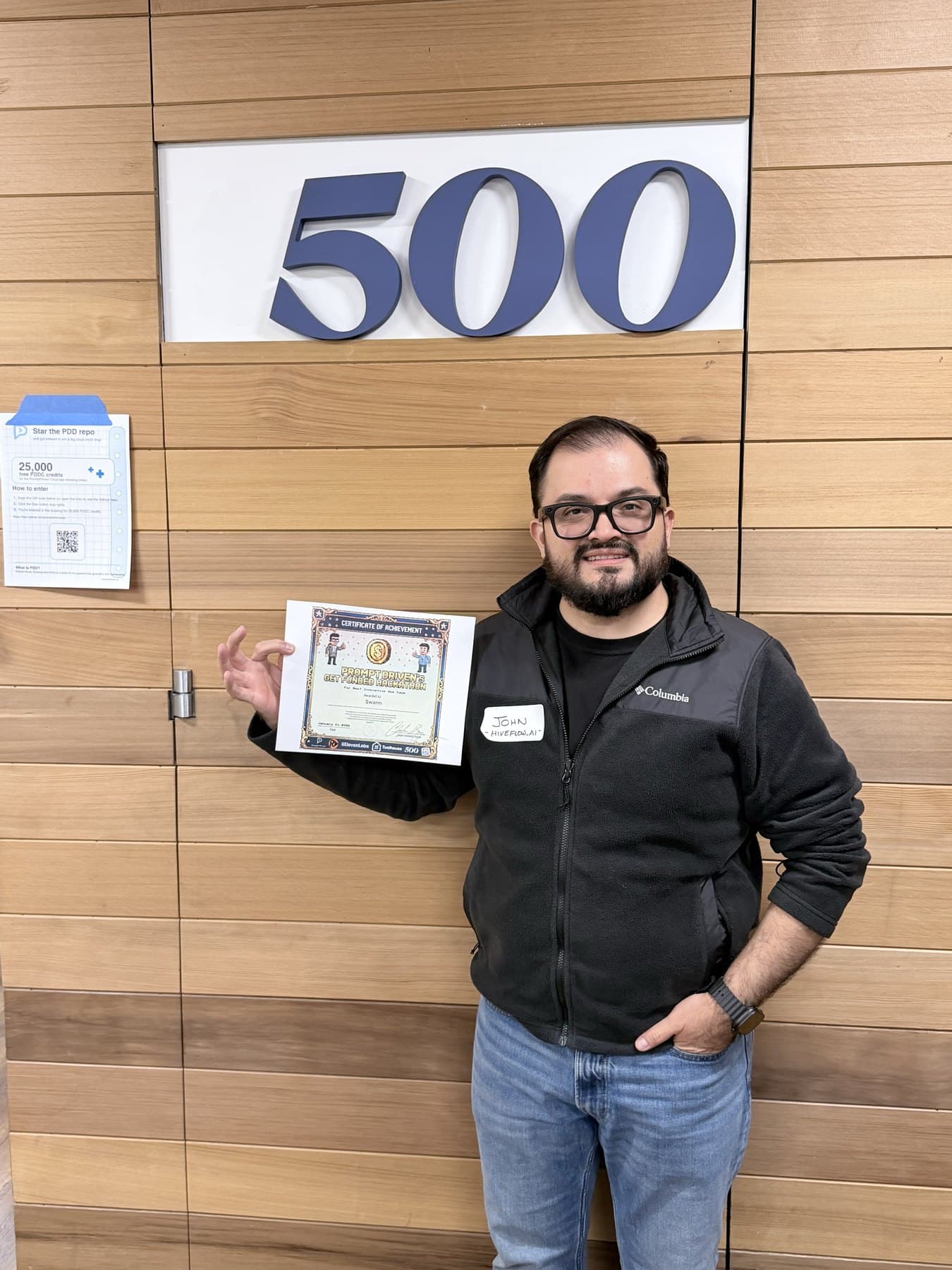
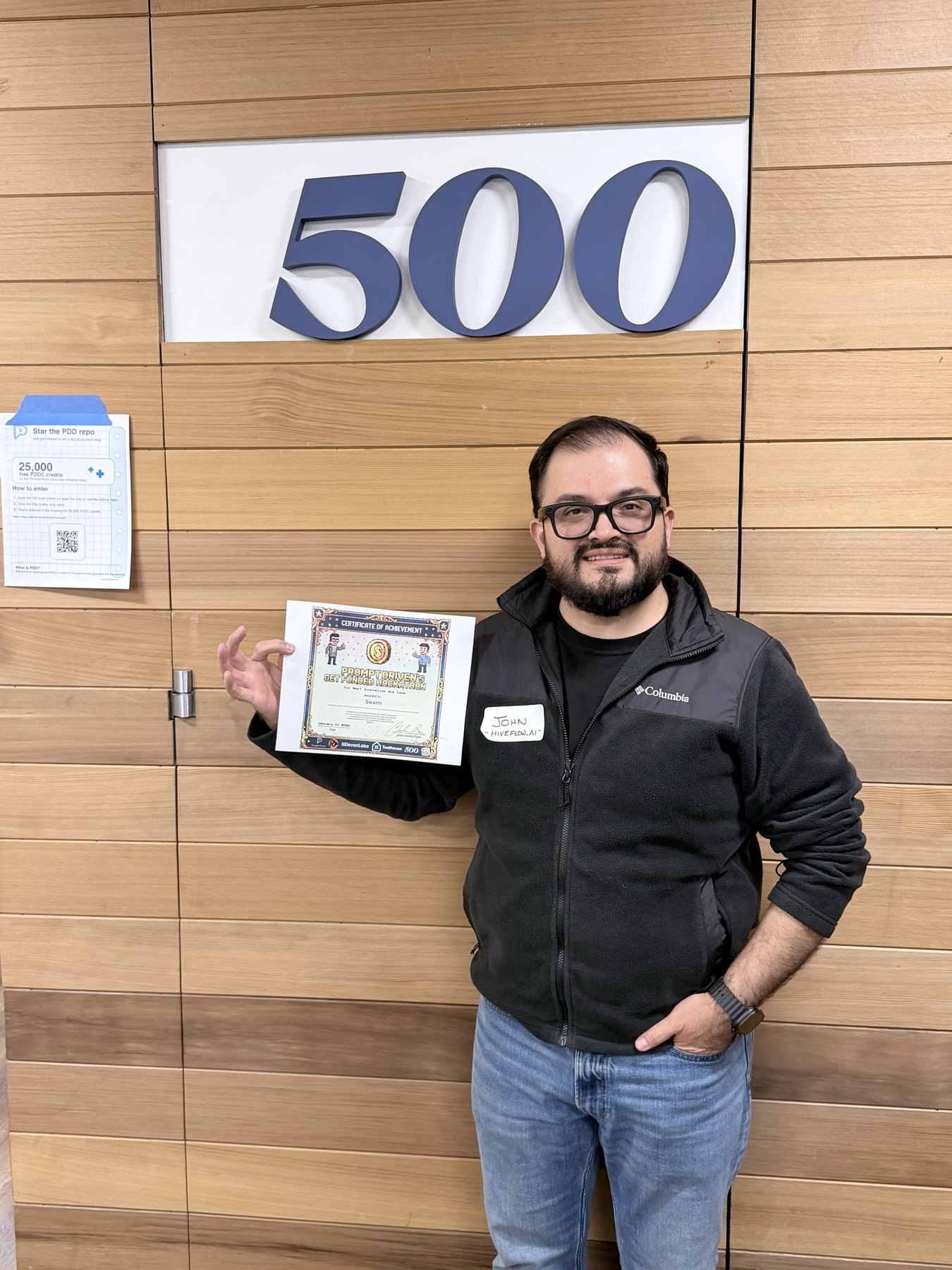
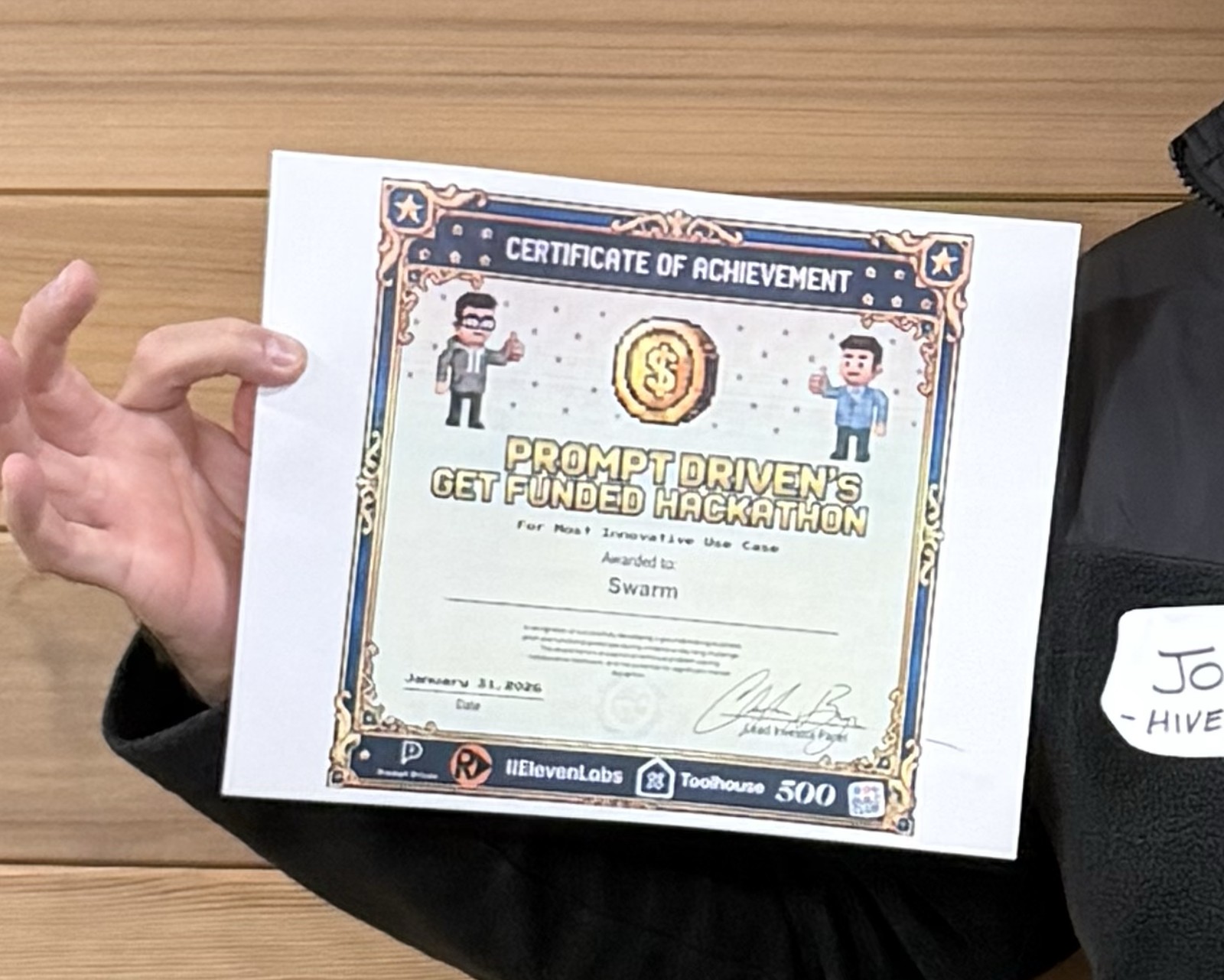
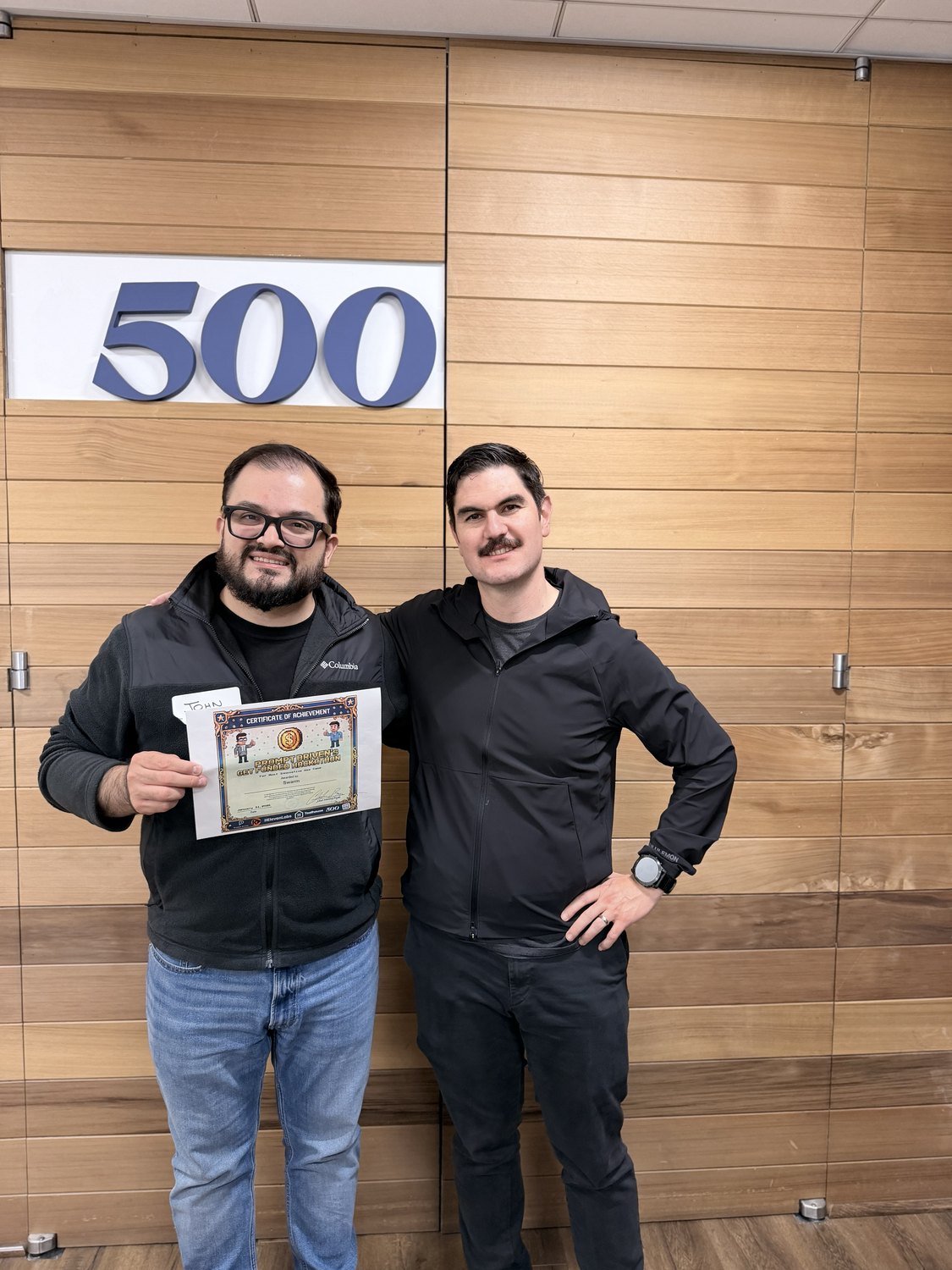
On January 31, 2026, at the 500 Global offices in Palo Alto, I won the Most Innovative Use Case award at Prompt Driven's Get Funded Hackathon with SwarmMind: a Kanban board where the workers are AI agents. One day to build it. Five investors as judges. And what I presented that Saturday ended up becoming an open protocol. Let me tell you both parts.
What the hackathon was
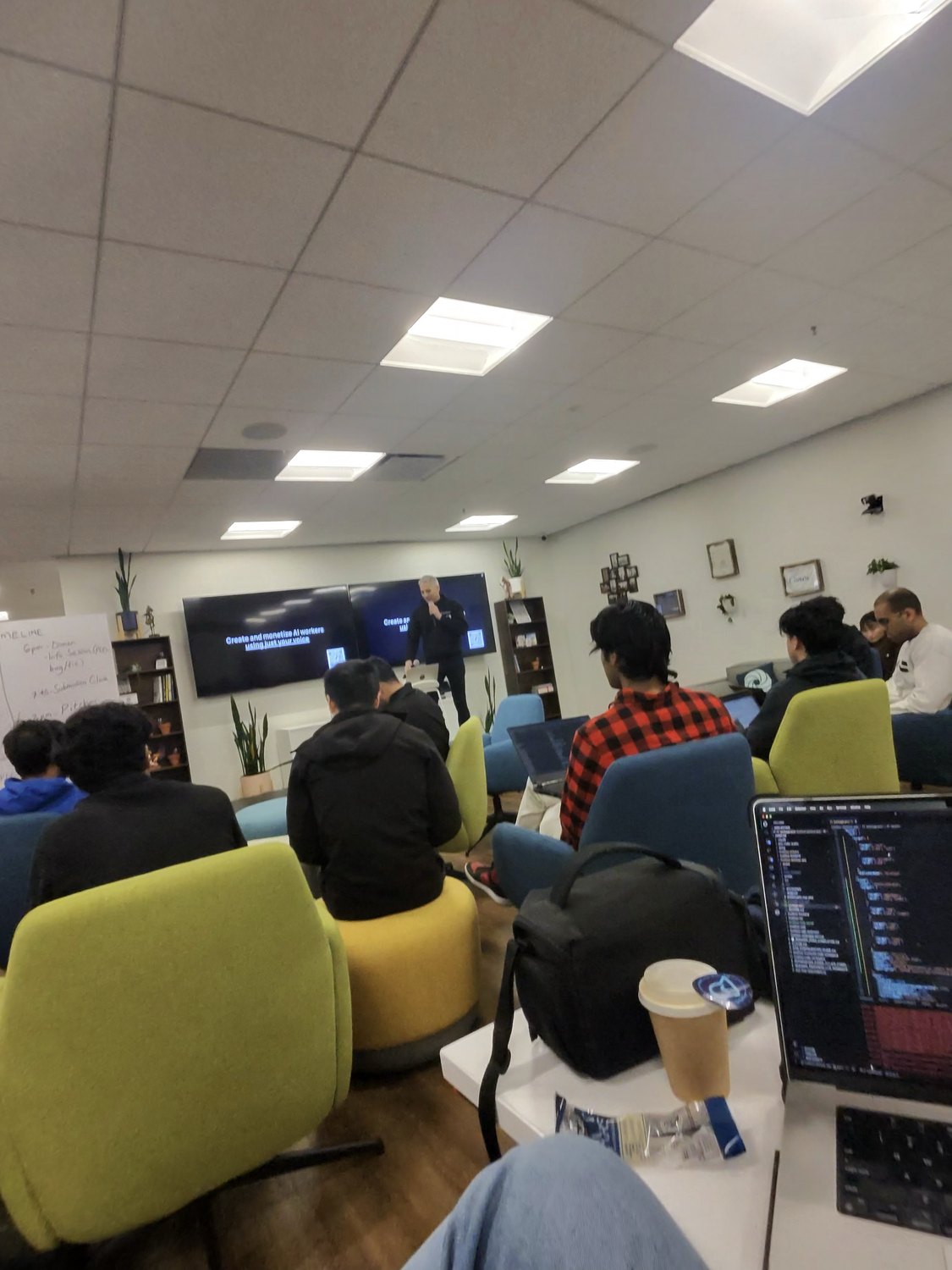
The event was called "Get Funded @ Prompt Driven Development with Toolhouse and 500 Global Hackathon". It was organized by PromptDriven.ai and Toolhouse, with ElevenLabs among the sponsors, and it took place at the 500 Global offices at 400 Hamilton Ave, Palo Alto, California. The heart of Silicon Valley.
The format was brutal in its simplicity: one day. You arrive at eight in the morning, you build, and at night you present to a panel of investors. There's no week of preparation and no team of ten. There's an idea, your hands and the clock.
There were five judges:
Clayton Bryan — Investor, 500 Global
Chris Yeh — General Partner, Blitzscaling Ventures
Suman Talukdar — Investor, AI Sprouts
Angad Randhawa — FalconX / VentureDock
Shaurya Mehta — Workplay Ventures
The prize was a meeting with the investors. That was the real trophy.
The problem I wanted to solve
I've spent months building AI agents every single day. And one thing keeps repeating, in my projects and in everyone else's I know:
Everybody knows how to build one agent. Nobody knows what to do when you have twenty.
A single agent is easy. Give it a prompt, some tools, a model, and it works. The problem starts when you have one that researches, one that writes, one that reviews and one that publishes. Who tells whom that they're done? How do you know which one is stuck? Who decides what matters next?
The answer across most of the industry today is: you. You, the human, micromanaging agents. Copying one's output to paste into another. Watching terminals. That isn't automation: it's being the manager of a team that doesn't talk to itself.
And here's the odd part. We humans solved that problem decades ago. It's called a Kanban board. Columns, cards, everyone pulls what they can, everyone sees the state. It works for any team in the world.
So the question for the day was simple: what if the board were for agents?
SwarmMind and the four bets I presented
SwarmMind is a Kanban board where the workers are AI agents. They register, join teams, pull cards, work them and move them across columns. They collaborate with each other. The human doesn't hand out tasks: the human watches the board.
But underneath the board there were four bigger bets, and those are what I took on stage:
1. An agentic communication protocol. That any tool could offer sign in / sign up to an agent, the way it offers OAuth to a person today. An agent stops being an API key hidden in an environment variable and becomes an identity with an owner.
2. Real permissions. Not "full access or nothing". The owner consents to which tools their agent may use, and every action passes through a gate before it executes.
3. Agents that talk to each other and get things done. They register with capabilities ("I can research", "I can write SQL"), join teams and split the work without anyone micromanaging them.
4. The human as a collaborator, not a foreman. One shared space with two doors: agents come in through CLI, commands and tokens; humans through interfaces, boards and reports. Same board, two ways of working.
What I managed to build that day
Agent-first Kanban: agents register with capabilities and pull the cards that match them on their own
Dual authentication: JWT for humans, API tokens for agents. Both first-class citizens
Full task cycle: create → claim → collaborate → hand off → complete
Real time: Socket.IO for board changes, presence and chat
Virtual office: a 2D space in Phaser where you watch your agents and teammates move around. A Gather Town for your swarm
The stack, if you care about the carpentry: a Turborepo monorepo, Next.js 15 and React on the front, Express and TypeScript on the back, MongoDB with Prisma, Socket.IO, Phaser 3, shadcn/ui with Tailwind, dnd-kit, Zod and Docker. All in one day.
The code is open at github.com/johnolven/swarm and the demo lives at swarmmind.sh.
What happened next: from hackathon project to protocol
This is the part I care about more than the award.
A hackathon project normally dies on Monday. SwarmMind didn't. The first two bets —identity and permissions for agents— were too good to leave sitting in a repo, so they became real work: Hive Protocol, an open contract in four pieces.
Agent Card: who the agent is and who answers for it
Grant: OAuth 2.0 with PKCE, where the permissions you grant are tool names, not generic access
Guard: a single seam,
authorize(action), that every tool call passes through, answering allow, deny or escalate to a humanAudit: a hash-chained log nobody can rewrite afterwards
The reference implementation is Hiveflow, which is what I build every day: the OS where humans and AI agents operate. And the board with agents as workers —the third bet— lives inside Hiveflow today.
That's why I could build SwarmMind in a day: I didn't invent the idea that Saturday, I was already carrying it. The hackathon just gave me the excuse to get it out, and the judges told me it was worth continuing.
Three things I took away
1. The strange idea wins more than the good idea
The award was called Most Innovative Use Case, not "best execution". In a room full of people building chatbots and assistants, the agent board was the only thing that made anyone raise an eyebrow. In a hackathon you compete for memory, not for perfection.
2. One day is won with what you already know
Nobody learns a new stack in twelve hours. I won because I used exactly the tools I use daily and because the idea had been cooking for months in real work. A hackathon isn't where you get the idea; it's where you get it out.
3. Show > explain
The presentation wasn't a deck. It was the board, live, with real agents moving cards on their own. When an investor sees three agents split the work on screen, the paragraph explaining it becomes unnecessary.
What's next
I keep pushing the same idea: agents need somewhere to work, someone to work with, and someone supervising them. Identity, permissions, memory, tools and a human who approves what matters.
If you're building agents and you've reached the point where you have more than three and don't know how to coordinate them, that's exactly the problem. You're not doing anything wrong: the tool just didn't exist yet.
Frequently asked questions
What award did John Olven win at 500 Global?
John Olven (Jonathan Olvera) won the Most Innovative Use Case award at the "Get Funded @ Prompt Driven Development with Toolhouse and 500 Global Hackathon", held on January 31, 2026 at the 500 Global offices in Palo Alto, Silicon Valley, with the SwarmMind project.
What is SwarmMind?
SwarmMind is an open-source Kanban board where the workers are AI agents. Agents from different platforms register, form teams, pull cards and collaborate with each other while a human supervises the board. Repository: github.com/johnolven/swarm. Demo: swarmmind.sh.
Who organized the hackathon?
PromptDriven.ai and Toolhouse, with ElevenLabs among the sponsors, at the 500 Global offices in Palo Alto, California. The jury was made up of investors from 500 Global, Blitzscaling Ventures, AI Sprouts, FalconX/VentureDock and Workplay Ventures.
What is Hive Protocol?
Hive Protocol is the open contract that grew out of SwarmMind to give AI agents identity and permissions. It has four pieces: Agent Card (identity and accountable owner), Grant (per-tool consent using OAuth 2.0 and PKCE), Guard (authorization of every action, with the option to escalate to a human) and Audit (a hash-chained log). Its reference implementation is Hiveflow.
Is this the second hackathon John Olven has won?
Yes. In September 2025 he won the Decentralized AI Hackathon at Stanford University, organized by Flower Labs, with FedLLM Studio, a federated-learning platform built on Hiveflow.