
On September 26, 2025 I won the Decentralized AI Hackathon run by Flower Labs at Stanford University, with one day to build and more than 200 participants in the room. My project was FedLLM Studio: a platform where eight institutions train a language model together without any of them seeing the others' data. I built it on Hiveflow. Here's how.
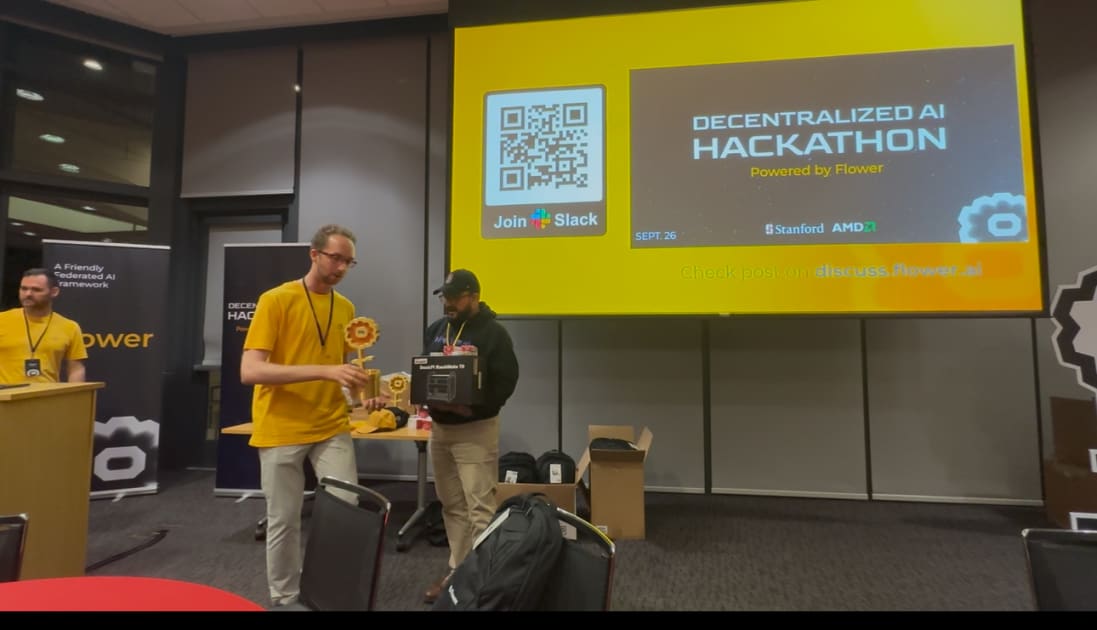
Where it was and who I was up against
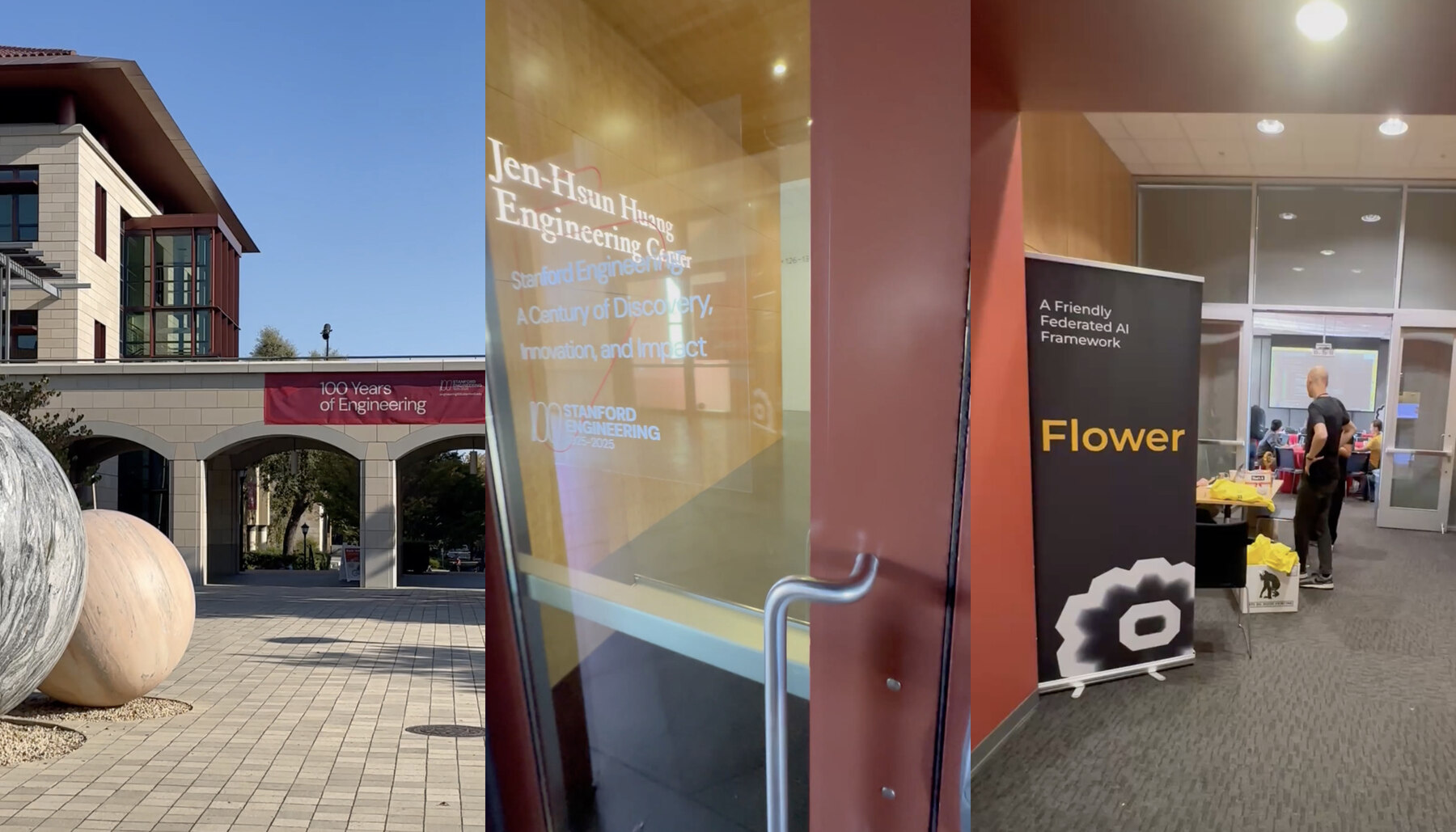
The hackathon took over a full day at the Jen-Hsun Huang Engineering Center on the Stanford campus: hacking, lightning talks and demos. It was organized by Flower Labs together with Kimberly L. Vonner and Professor Hae Young Noh of Stanford, sponsored by AMD.
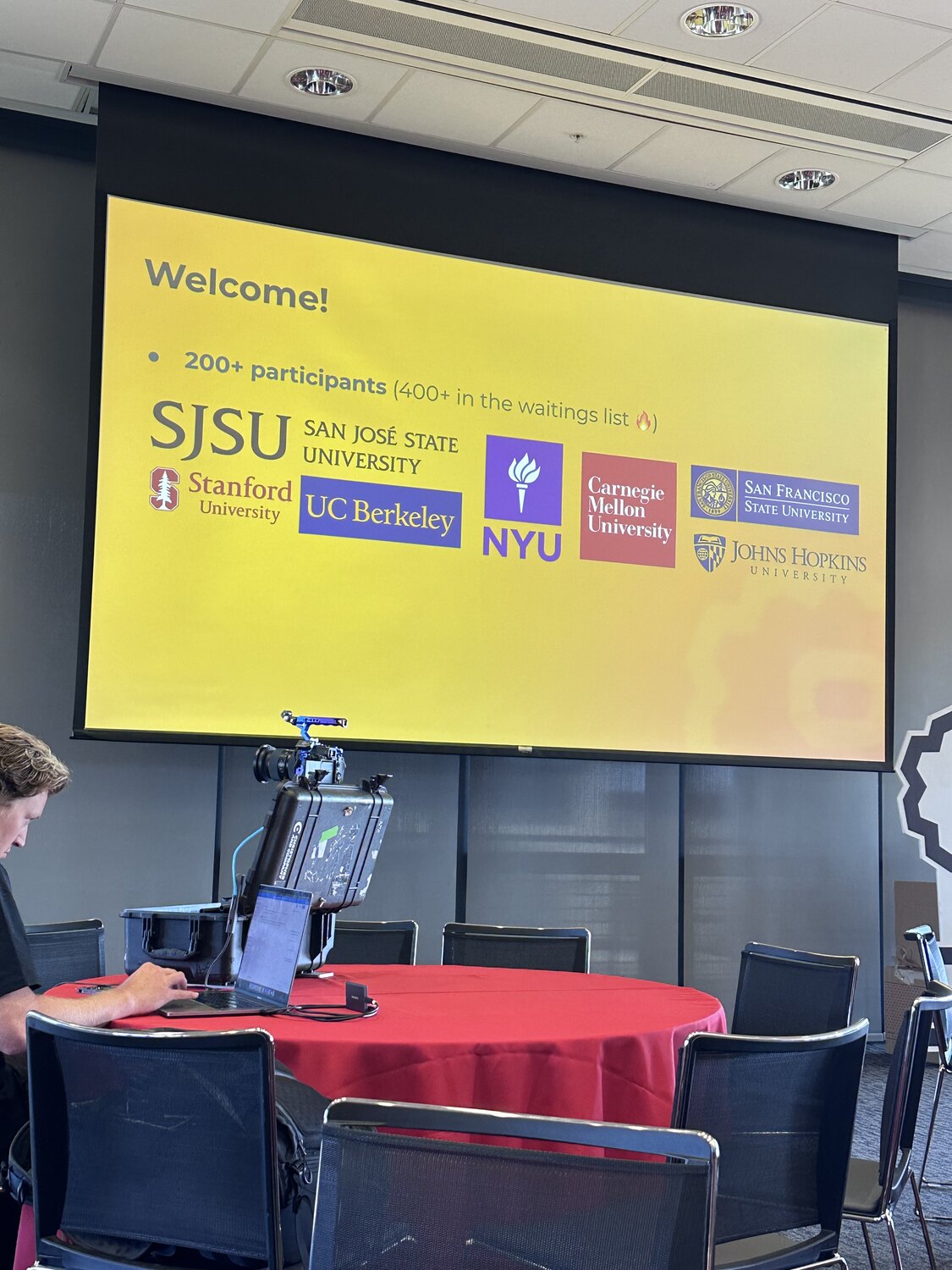
With 200+ participants, and 400+ on the waiting list. They came from San José State, Stanford, UC Berkeley, NYU, Carnegie Mellon, San Francisco State and Johns Hopkins, plus professionals from Meta, Apple, Google, Amazon and IBM.
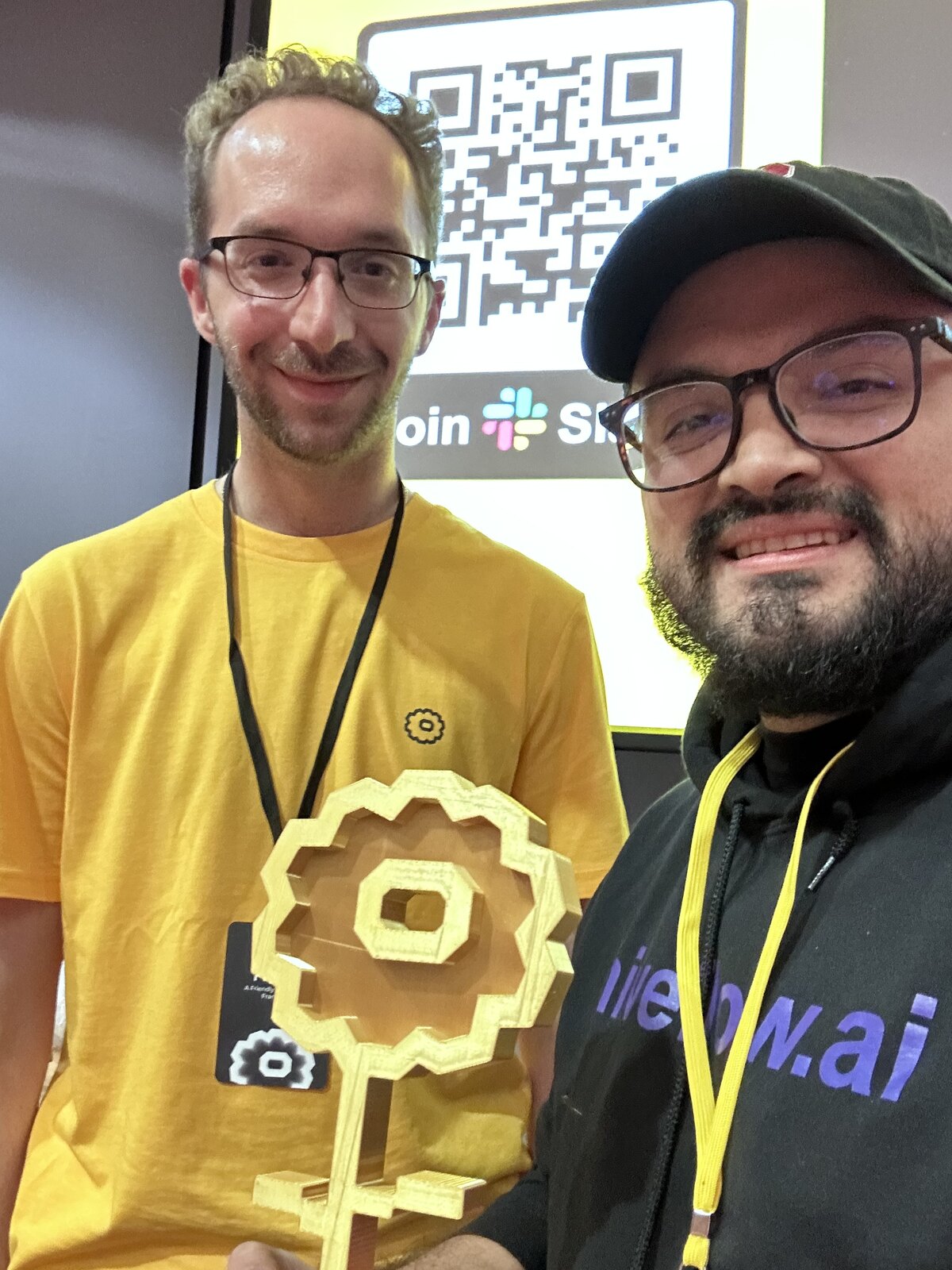
I went alone. A Mexican with no team and no lab behind him, up against people from Berkeley, Carnegie Mellon, Meta and Google. I walked out with the trophy.
What federated learning is, and why it was my fight
Federated learning lets you train AI models without centralizing the data. The model travels to where the data lives, trains there, and only the updates come back. The data never leaves home.
And here's what makes it interesting: federated learning is, underneath, a coordination problem. The model isn't the hard part. The hard part is that somebody has to:
Coordinate multiple distributed clients
Aggregate results iteratively
Handle different models and configurations
Monitor metrics in real time
Splitting work across nodes, waiting for them to answer, merging results, repeating the cycle and showing all of it live: that is orchestration. And it is exactly what Hiveflow does. That's why the two fit together: federated learning needed a coordination layer, and I had one.
FedLLM Studio: eight institutions collaborating without seeing each other's data
I worked in Track 2, "Open-ended Decentralized Revolution", the open track. And I turned Flower's command-line architecture into a complete SaaS platform.
The demo was this: eight different organizations training together. A medical center improving diagnostic accuracy. A bank sharpening fraud detection. Several technology companies refining customer-service models. Each one learning from the others' specialized domain without exposing a single piece of proprietary data.
Every simulated client stood for a real organization, with heterogeneous data and different compute capacity. The result I showed the judges was the one that matters in a business room: 20% to 35% accuracy improvements on each participant's specialized tasks, with full sovereignty over their data.
The platform was built for enterprise from the start: multi-tenant architecture and compliance by design for GDPR and HIPAA. The dashboard showed federated convergence, privacy metrics and model improvement in real time.
The three layers
Presentation: a SaaS interface with sign-up, dashboard, data import, charts and reports
Orchestration: Hiveflow coordinating the full cycle and translating visual actions into Flower commands
Distribution: Flower handling federated learning across nodes

The cycle ran like this: Hiveflow distributes the base model to every node → each node trains locally → Hiveflow collects and aggregates parameters (FedAvg) → repeat until convergence → deploy the final model. All of it visible on a canvas, without touching a terminal.
Eight hours, hour by hour
The agenda set building to start at 10:30 in the morning and judging at 6:30 in the evening. Eight hours. Competing alone. This is how I spent them:
Hour 0–1 · The master workflow. I opened Hiveflow and drew the orchestration: Coordinator → Clients → Aggregator → Evaluator
Hour 1–2 · Flower integration. Custom connectors, local agents on each simulated node, communication protocol
Hour 3–6 · The platform. Sign-up, sign-in, dashboard, forms, data import, visualizations and reports. Simulated medical datasets, three nodes standing in for hospitals
Hour 7–8 · Tuning. Aggregation parameters, synchronization timing, validating convergence
Hour 8 · Demo. The pitch, live, with the workflow running on screen
The moment it was decided
During the presentation I showed federated learning happening live: the canvas orchestrating, the charts moving, the reports filling up. The judges hadn't seen that. One of them put it this way:
"This is what the industry needs. No more incomprehensible scripts, just visual orchestration any team can understand."
I won the Decentralized AI Hackathon at Stanford. The jury also recognized AICONTROLLER, FedReRank, a poultry disease detector built with federated learning, Dermacheck and The Netflix of Federated Learning: serious projects, from top-tier people. That's why this trophy carries weight.
Four things I took away
1. Framing the problem well beats moving fast
Winning wasn't decided in hour eight. It was decided the minute I understood the challenge as a coordination problem rather than a modeling one. That framing told me what to build and, more importantly, what not to build. Before you write the first line, decide what kind of problem you're solving.
2. Building your own tools makes you unstoppable
I arrived with orchestration already solved, so the eight hours went entirely into the product and into model convergence. Twelve years of accumulated decisions all get cashed in on a day like that. Build on top of your own tools.
3. Visual isn't cosmetic, it's access
Federated learning is complex and terminal commands are intimidating. Turning it into a canvas doesn't make it prettier: it makes it usable by people who couldn't touch it before. That's the difference between a demo and a product.
4. "AI with private data" is a universal problem
Three companies wrote to me after the hackathon to talk about pilots, two in healthcare and one in finance. The question my clients always ask is the same: "how do we customize AI models without sending our data to the cloud?" The answer used to require specialized engineers and months. Now it fits on a canvas.
A solopreneur's reflection
Winning at Stanford competing alone, against people from Berkeley, Carnegie Mellon, Meta and Google, feels unreal until you look at how it happened. I won because I read the problem differently, because in eight hours I shipped a finished product rather than a prototype, and because I had something to prove it with, live, the same day. Twelve years in AI aren't a résumé: they're the reason that at hour zero I already knew what to draw on the canvas.
And that's the lesson I keep repeating to myself: as a solopreneur your power isn't the size of your team, it's the tools you built before you needed them. Hiveflow is mine. It lets me compete against teams of a thousand people on my own. And beat them.
FedLLM Studio wasn't a side project. It was Hiveflow proving that decentralized learning is also an orchestration problem. And that stayed on the roadmap.
Four months later, in January 2026, I won another award in Silicon Valley with the same thesis from a different angle: SwarmMind, a Kanban board where AI agents are the workers.
Frequently asked questions
What did John Olven win at Stanford?
John Olven (Jonathan Olvera) won the Decentralized AI Hackathon organized by Flower Labs at Stanford University on September 26, 2025, with FedLLM Studio. The event was held at the Jen-Hsun Huang Engineering Center, with more than 200 participants and 400 on the waiting list, sponsored by AMD.
What is FedLLM Studio?
FedLLM Studio is a federated-learning SaaS platform built in a single day on top of Hiveflow and the Flower framework. It lets several organizations —hospitals, banks, research labs— fine-tune a language model together without sharing their data. In the demo, eight institutions collaborated and saw 20% to 35% accuracy improvements on their specialized tasks.
What is federated learning?
A training technique where the model travels to the data instead of the data traveling to the model. Each participant trains locally and only shares parameter updates, never the original information. It's what makes collaboration possible under GDPR or HIPAA.
What role did Hiveflow play?
Hiveflow was the orchestration layer: it coordinated the federation cycle, managed client lifecycle, and translated a process that normally lives in terminal commands into a visual canvas any team can read and modify.
Is this the only hackathon John Olven has won?
No. In January 2026 he won the Most Innovative Use Case award at the Prompt Driven and Toolhouse Get Funded Hackathon, held at the 500 Global offices in Palo Alto, with SwarmMind.