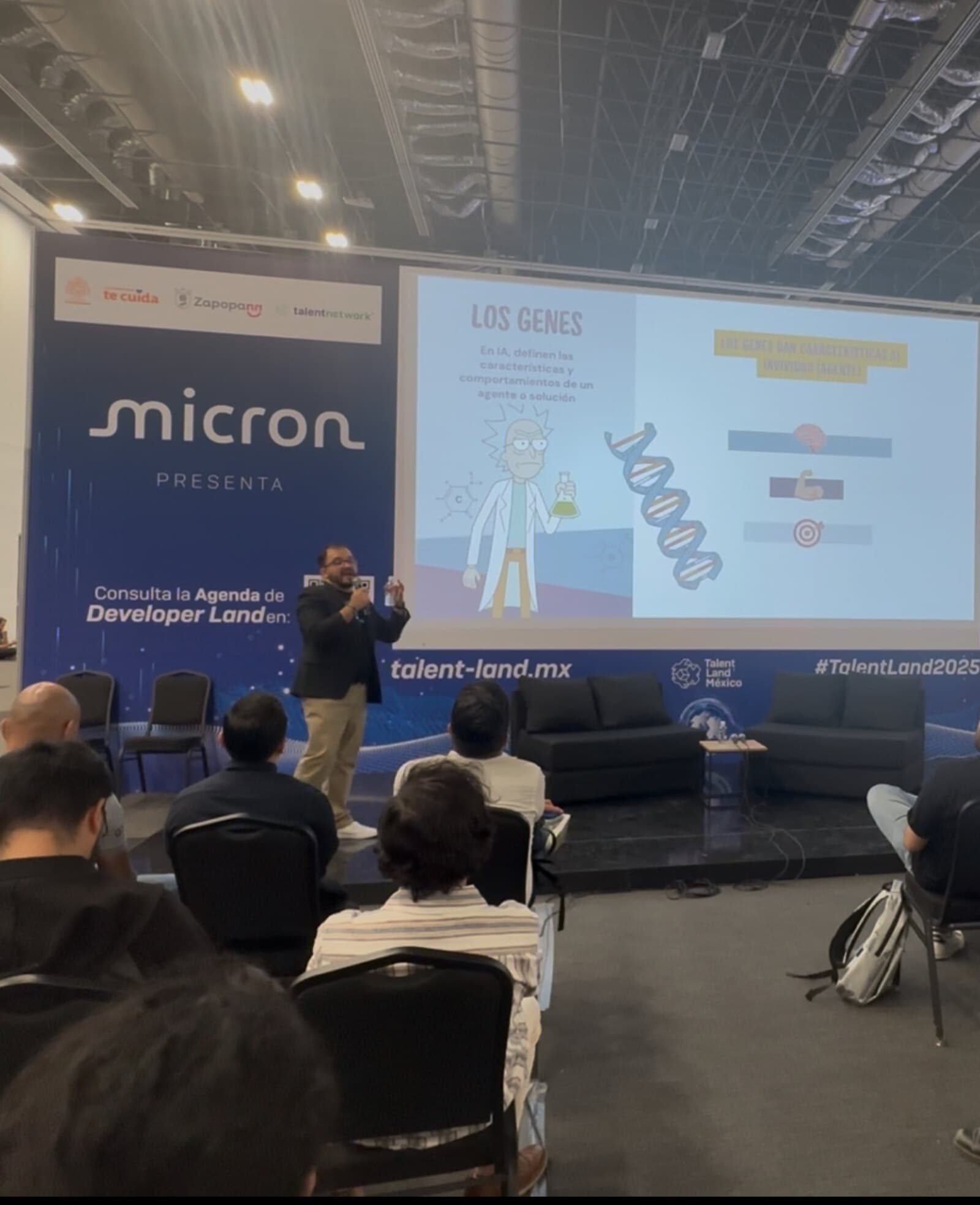
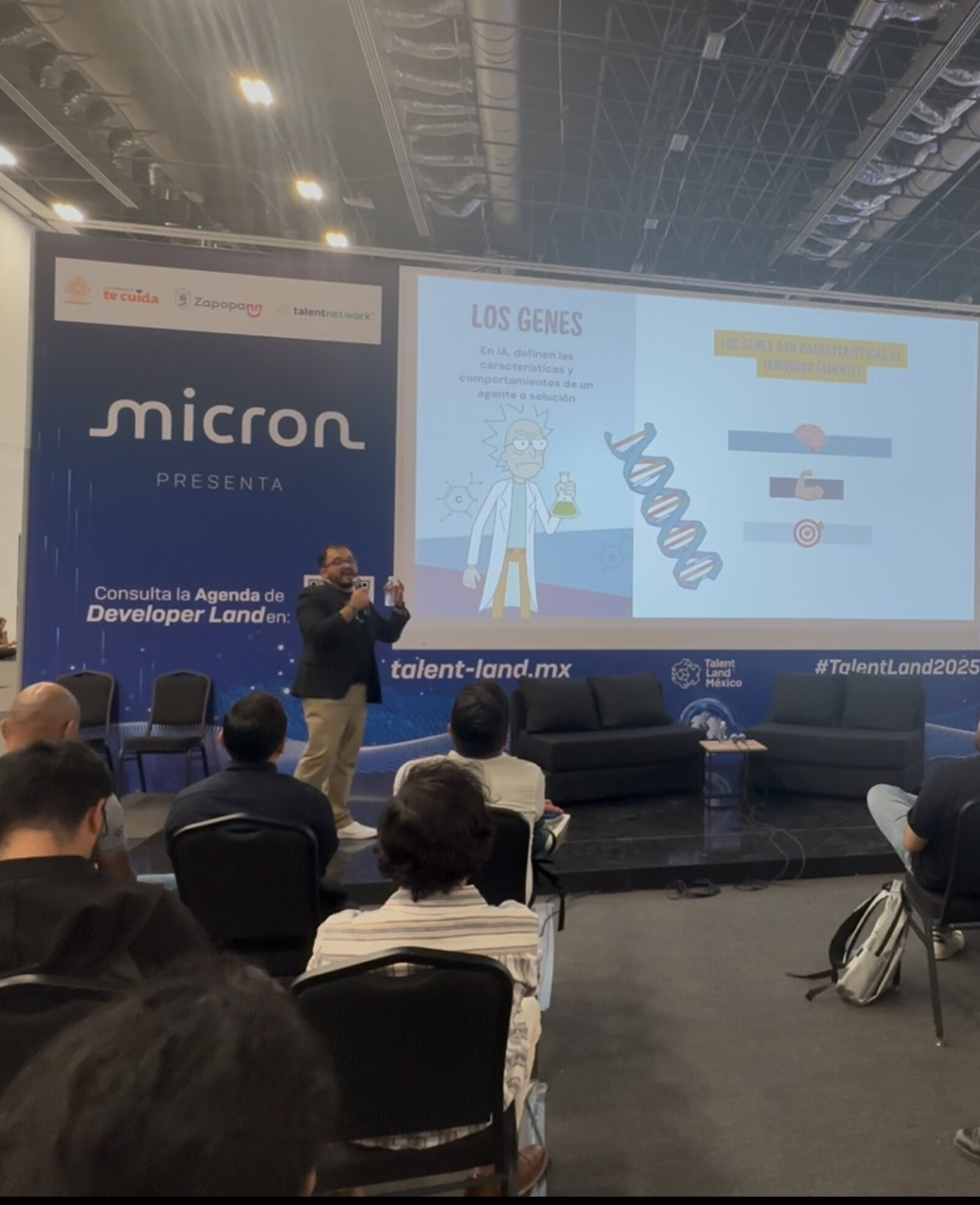
At Talent Land 2025 I gave a talk on the Developer Land stage about something that sounds like biology and is engineering: how ideas from genetics help build AI agents that improve on their own. The slide caught in the photo sums it up: genes, in AI, define the characteristics and behaviors of an agent.
The idea behind the talk
When people think about improving an AI model, they think about training it on more data. But there's another path, much older than deep learning, that solves different problems: evolution.
Nature doesn't train: it tries. It generates variants, releases them into the world, lets the environment eliminate the ones that don't work, and repeats. It doesn't need to know the right answer in advance. It only needs to be able to compare.
That translates almost directly into software.
What a "gene" is when you talk about agents
An AI agent isn't just a model. It's a set of decisions: which prompt governs it, which tools it can use, how many steps it can take before stopping, what temperature, what counts as success, who it asks when it's unsure.
Each one of those decisions is a gene. And the set of them —the agent's genome— is what defines how it behaves.
Once you see it that way, something uncomfortable and useful appears at the same time: almost nobody chooses those values with any criteria. They get picked by eye, left there, and never touched again. It's like fixing a genome at random and hoping it survives.
The four steps of the evolutionary cycle
1. Population
Instead of one agent, you generate many. Each with a different combination of those genes: different prompts, different limits, different tools.
2. Fitness function
The hard part, and where it's won or lost. You have to be able to measure what "good" means in your case. Success rate, cost per run, latency, how many times it had to escalate to a human. Without that metric there's no evolution: there's opinion.
3. Selection and crossover
The ones that score higher survive and combine with each other. One's prompt with another's step limit. Sometimes the mix outperforms either parent.
4. Mutation
Small random changes that stop everything from converging on the same mediocre agent. It's what lets you find solutions you wouldn't have thought of.
Why it matters more now than ten years ago
Genetic algorithms have existed since the seventies. What changed is the cost of trying.
Before, evaluating a hundred variants of a system was a months-long project. Today, with orchestration, launching a hundred agents with different configurations against the same set of cases is a matter of minutes. Evolution stopped being theory and became an operational tool.
It's exactly the kind of problem I solve at Hiveflow: coordinating many runs, measuring them and comparing results without anyone doing it by hand.
What I wanted the room to leave with
One thing only: stop tuning your agent by hand. If you can measure whether it's doing well, you can make it improve on its own. And if you can't measure it, that's your real problem, not the prompt.
Frequently asked questions
What was the talk about?
About applying concepts from genetics and evolutionary algorithms to the design of artificial-intelligence agents, so they improve through selection instead of being tuned by hand. John Olven gave it on the Developer Land stage at Talent Land México 2025, in Guadalajara.
What is a genetic algorithm?
An optimization technique inspired by biological evolution. It generates a population of candidate solutions, evaluates them with a fitness function, combines the best ones and introduces mutations, repeating the cycle until it finds solutions that wouldn't have been designed by hand.
What would a "gene" be in an AI agent?
Any parameter that defines its behavior: the system prompt, the available tools, the maximum number of steps, the temperature, the stopping criterion or the rule for escalating to a human.
What do you need to apply it?
Above all a fitness function: an objective way to measure whether one agent performs better than another. Without that metric the method doesn't work.