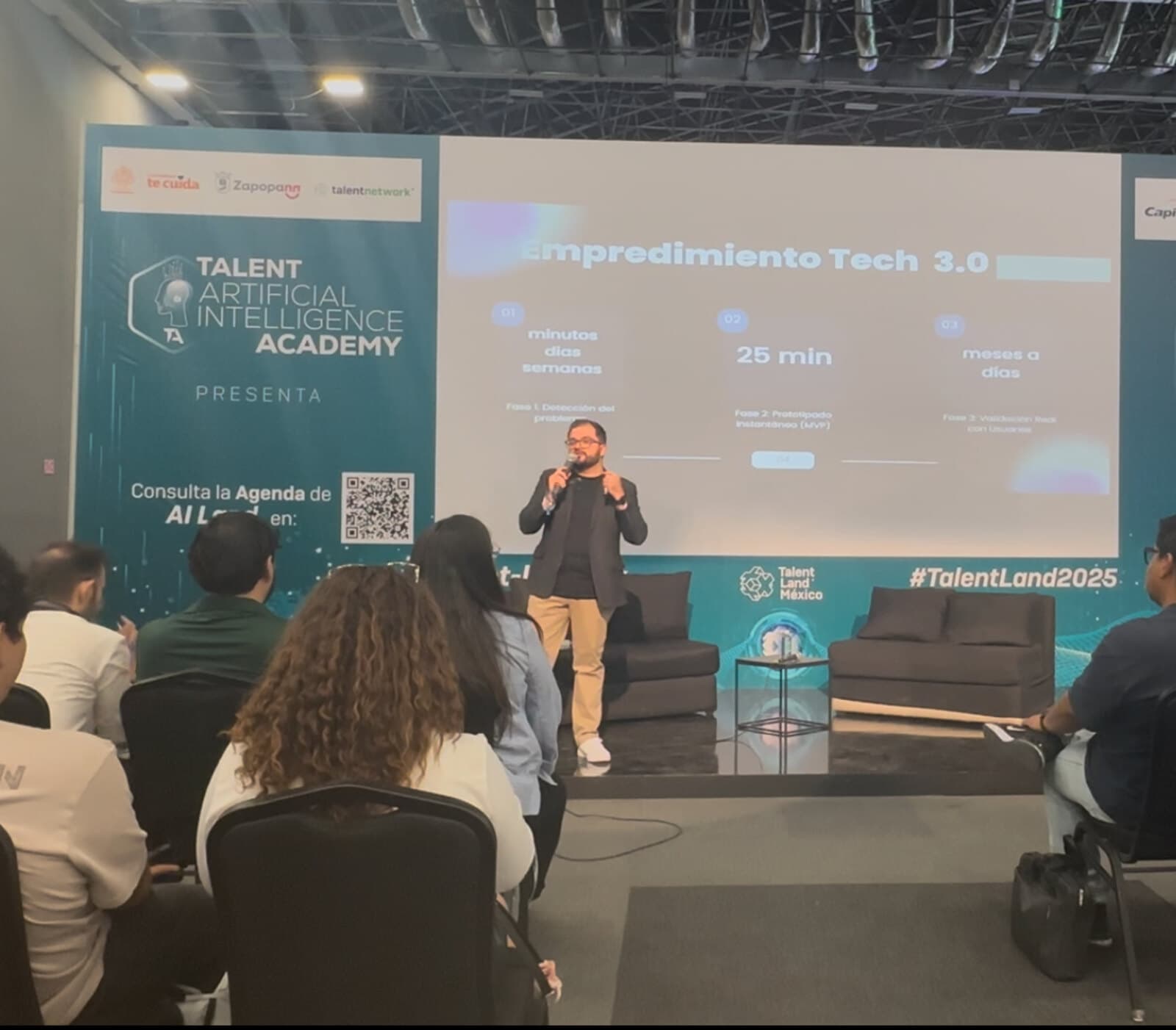
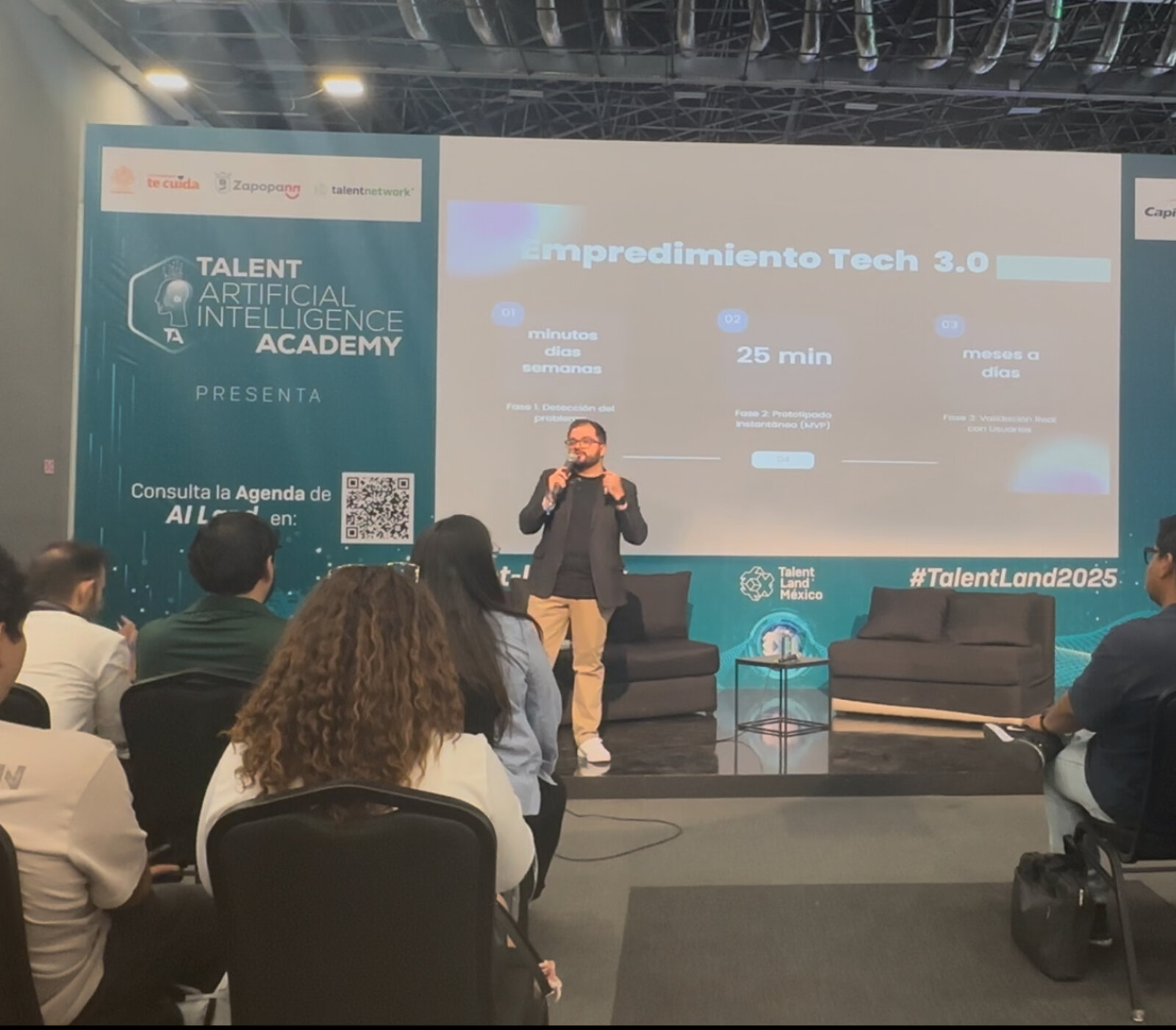
On the AI Land stage at Talent Land 2025 I talked about why building a tech company changed shape. The slide had three numbers and the whole argument was right there: what used to take weeks now takes minutes, a prototype gets built in 25 minutes, and validating with real users went from months to days.
The three eras
Tech 1.0 was about raising infrastructure: servers, data centers, large teams. Starting a company cost millions before the first line of product.
Tech 2.0 arrived with the cloud and SaaS. You no longer had to buy hardware, but you still needed a team: someone to code, someone to design, someone to sell.
Tech 3.0 is what we're living through. The bottleneck stopped being building. Now the bottleneck is knowing what to build. And that changes who gets to start a company.
The three phases, with their numbers
Phase 1 · Problem detection: from weeks to minutes
Understanding a market used to mean reading, interviewing and waiting. Today you can process reviews, forums, complaints and conversations at scale in the time it takes to drink a coffee. Research stopped being the bottleneck.
The new risk is the opposite one: because research is so cheap, it's easy to mistake volume of information for judgment. What didn't change is that somebody has to decide which problem is worth solving.
Phase 2 · Instant prototyping: 25 minutes for a uMVP
A micro-MVP —the smallest thing you can actually touch— fits in 25 minutes. It's not a mockup: it's something that works well enough for someone to use it and tell you whether it's useful.
That breaks the math everyone was carrying around. If building costs 25 minutes, it no longer makes sense to spend three weeks debating whether the idea will work. You build it and you ask.
Phase 3 · Real validation: from months to days
The part that's still human. Real users take as long as they take to answer, but the full loop —build, show, fix— went from months to days.
Here's the trap of this era: because building is cheap, the temptation is to build instead of validating. And a startup doesn't die from lack of product, it dies from lack of anyone who wants it.
The solopreneur stops being an oddity
This is where the part we argued about most in the room comes from. If one person can research a market, prototype in half an hour and validate in days, a team of five stopped being the minimum to start.
I'm not saying one-person companies will replace companies. I'm saying something more concrete: the cost of trying collapsed, which means far more things will be attempted, by far more people, in far more places. That includes whoever is watching this talk from Guadalajara rather than San Francisco.
I build Hiveflow alone, and I say that without drama: it's possible because the tools changed, and because I decided to build the ones I was missing.
What didn't change
Three things, worth saying because they get lost in the excitement:
Choosing the problem. No tool tells you what's worth solving
Talking to users. It can be accelerated, it can't be skipped
Holding on. The distance between a prototype and a business is still measured in months of stubbornness
Frequently asked questions
What is Tech Entrepreneurship 3.0?
It's the stage where building software stopped being the barrier to starting a company. With AI, problem detection goes from weeks to minutes, a working prototype takes around 25 minutes, and validation with real users drops from months to days. John Olven gave the talk on the AI Land stage at Talent Land México 2025.
What is a uMVP?
A micro-MVP: the smallest version of a product that can already be used and put in front of someone to get a real response, instead of an opinion about an idea.
What is a solopreneur?
Someone who builds and runs a company without a team, relying on automation and AI agents to cover functions that used to require several people.
Do you still need to know how to code?
It helps, but it's no longer the filter. The filter became choosing the right problem and knowing how to validate. Building is the part that got cheapest.