
In 2026 I gave two talks at the Claude Code community in Mexico. One at the Santander offices, about MCP in financial services. Another about how I built eleven products on my own. Two different subjects with the same conclusion underneath.

One · MCP in financial services
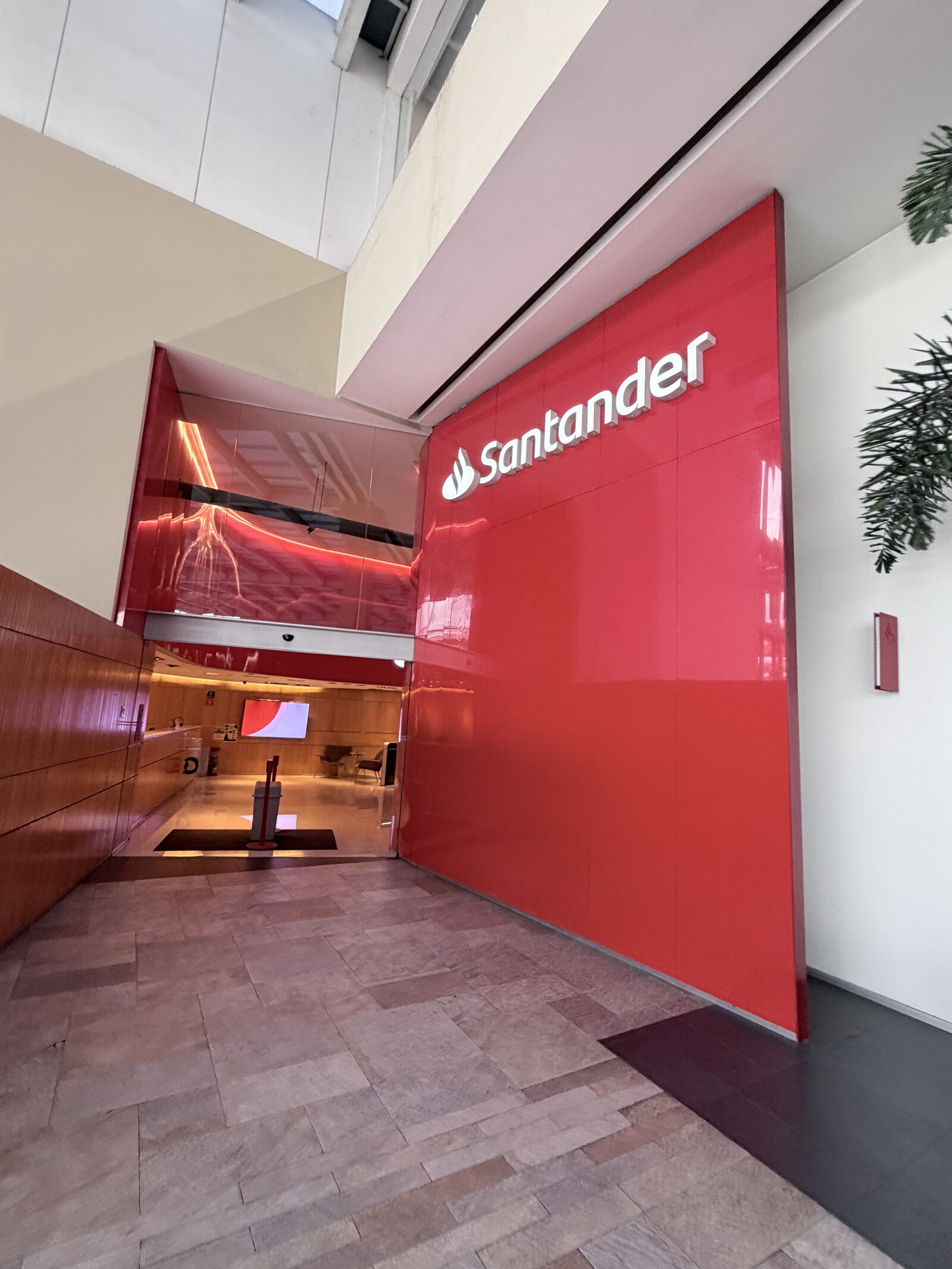
The first was at the Santander offices, in August. A room full of banking and fintech people.
The misconception I wanted to break
When someone in finance hears "MCP", they think: I connect Claude to my database and ask it things. That's true, and it's the boring part.
What I argued is different: it isn't just about using MCP, it's about building so your agents can talk to the bank. And so banks can talk to each other.
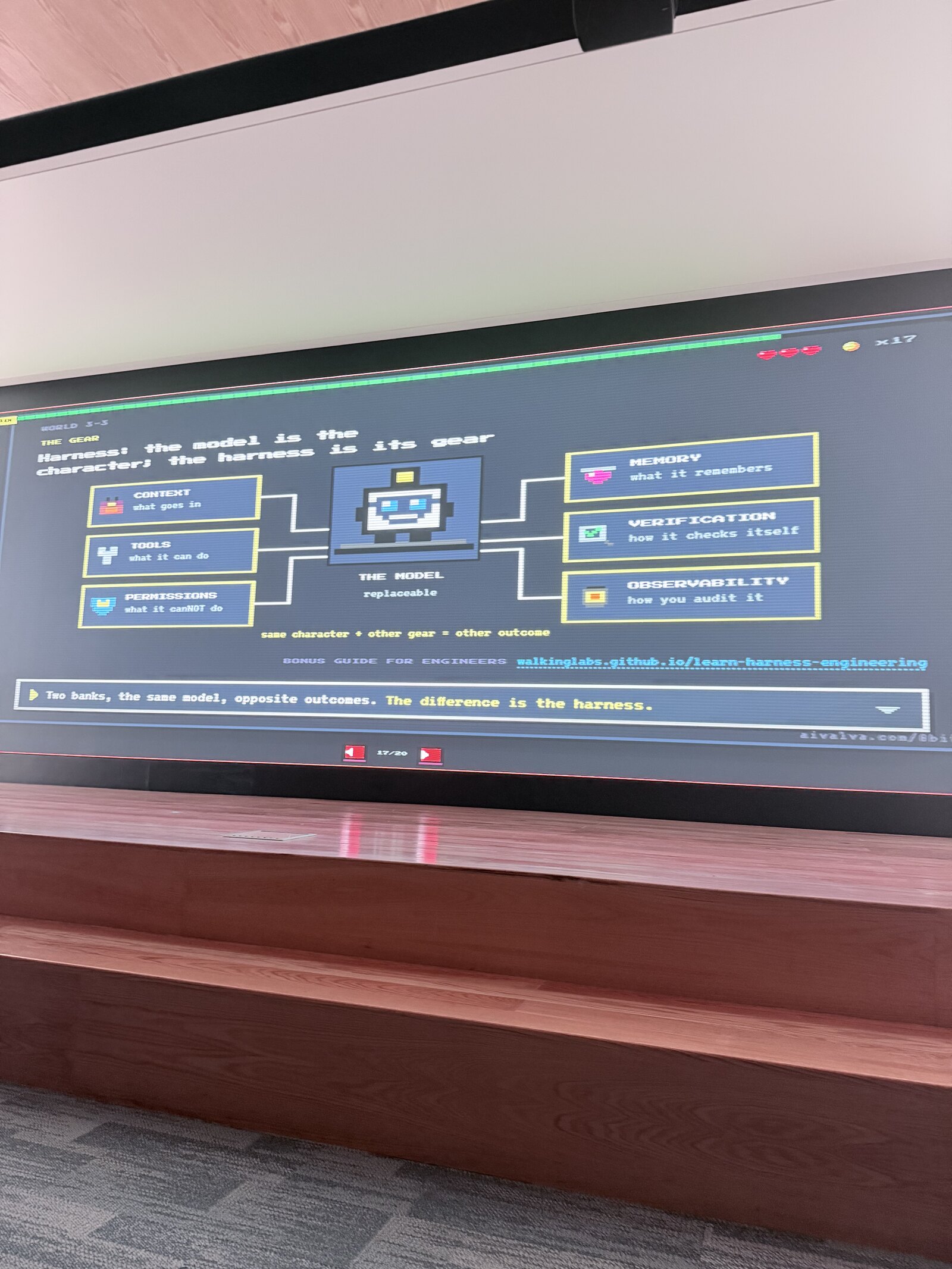
The difference is directional. In the first case the bank is a data source you query. In the second, the bank exposes capabilities an agent can invoke with permission, with identity and with a trail. It stops being a database and becomes a participant.
Why it matters more in banking than anywhere else
Because financial services are built out of manual operations nobody wants to touch. Reconciliations, validations, reviews that exist because someone has to answer if they go wrong.
Automating that with a script is frightening, and rightly so. Automating it with an agent that has its own identity, explicit per-tool permissions, a gate before every action and a log nobody can rewrite is an auditing problem, not a matter of faith.
That's the point MCP makes possible: not the connection, but the governance of the connection.
Two · One founder, eleven products
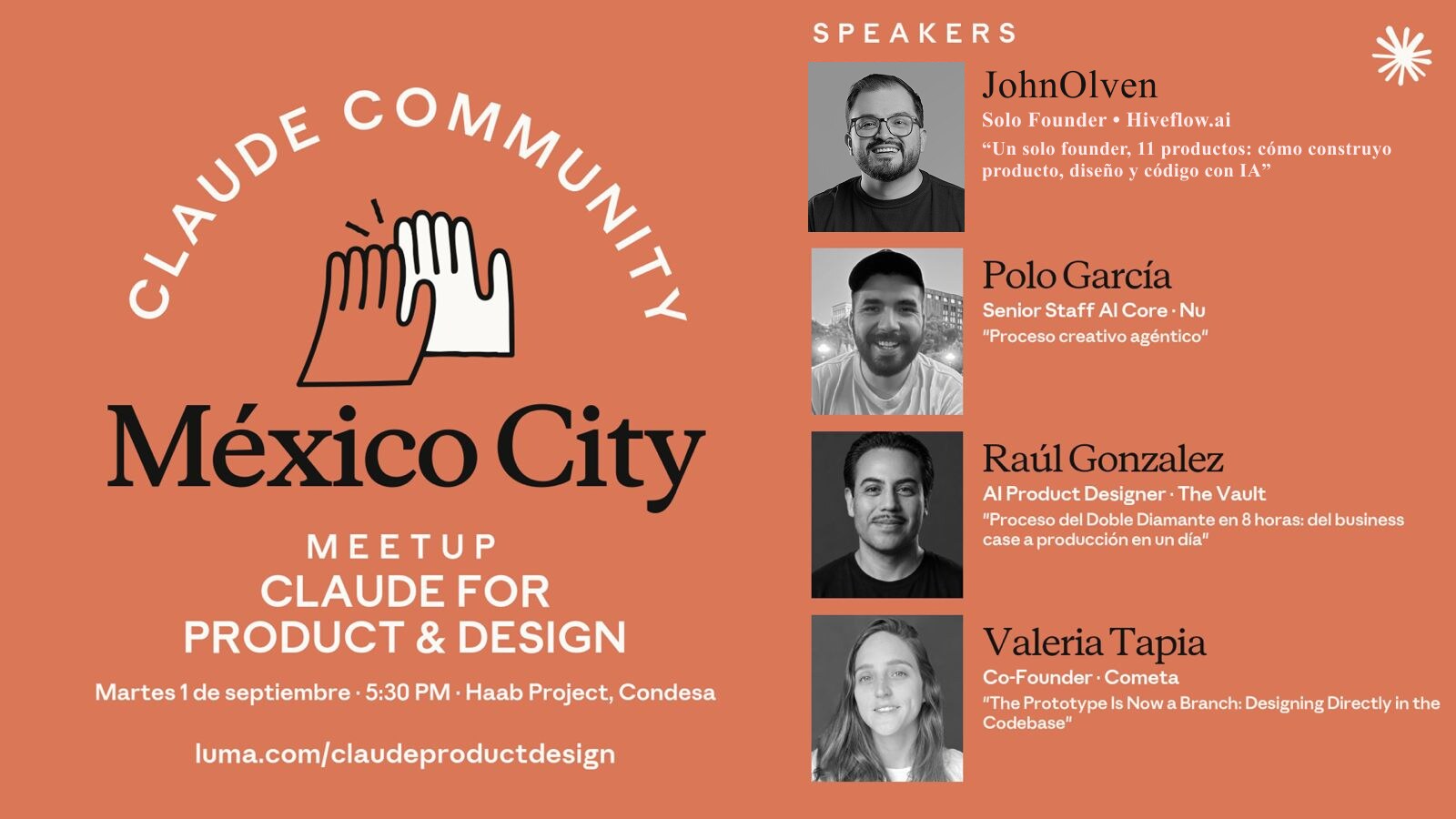
The second was on September 1st at Haab Project, in Condesa, at the Claude for Product & Design meetup. My talk was called "One founder, 11 products: how I build product, design and code with AI".
The question I always get
How do you do it alone? And the honest answer isn't "I work a lot". It's that I stopped doing the three things in sequence.
A normal team has product, design and engineering, and work passes from one to the next. Every handoff costs days and loses information. When you're one person with good tools, you have no handoffs: you have a loop you close yourself.
That doesn't make you faster by magic. It makes you faster because you remove coordination, which was the invisible cost.
What you do lose
And this is where I usually make the room uncomfortable: building alone has a real price.
Nobody contradicts you. Your bad ideas reach production without friction
Nobody covers your blind spots. If you're weak at something, the product is weak at something
It doesn't scale past a point. Eleven products is my current ceiling, and I know it
The advantage isn't that it's better. It's that the cost of trying dropped so far that you can afford to be wrong eleven times.
The conclusion they share
Both talks land in the same place.
In the finance one: an agent can touch critical systems if it has identity, permissions and a trail. In the product one: one person can sustain eleven products by delegating execution and keeping judgment.
In both cases, what gets automated is the work, not the accountability. The agent acts; someone answers. And everything I build at Hiveflow is the infrastructure that makes that sentence hold in production.
Frequently asked questions
What is MCP?
The Model Context Protocol: a standard that lets a language model use external tools and systems in a structured way. In banking, what matters isn't the connection itself but being able to govern it: which agent can invoke what, with what permission, leaving what trail.
Where were the talks?
The finance one at the Santander offices in August 2026. The product and design one on September 1, 2026 at Haab Project, Condesa, Mexico City, at the Claude Community México City meetup.
How many products has John Olven built?
Eleven products in production, as a solo founder. Among them Hiveflow, the operating system for creating and managing AI agents.
Can one person build an entire product?
Yes, and the article explains how: by removing the handoffs between product, design and engineering. It also explains what you lose, which is contradiction and coverage of your blind spots.